Postcards |
Intro van Gogh |
His Suicide |
van Gogh postcard
beautiful offset-printed
on 320 grs carton
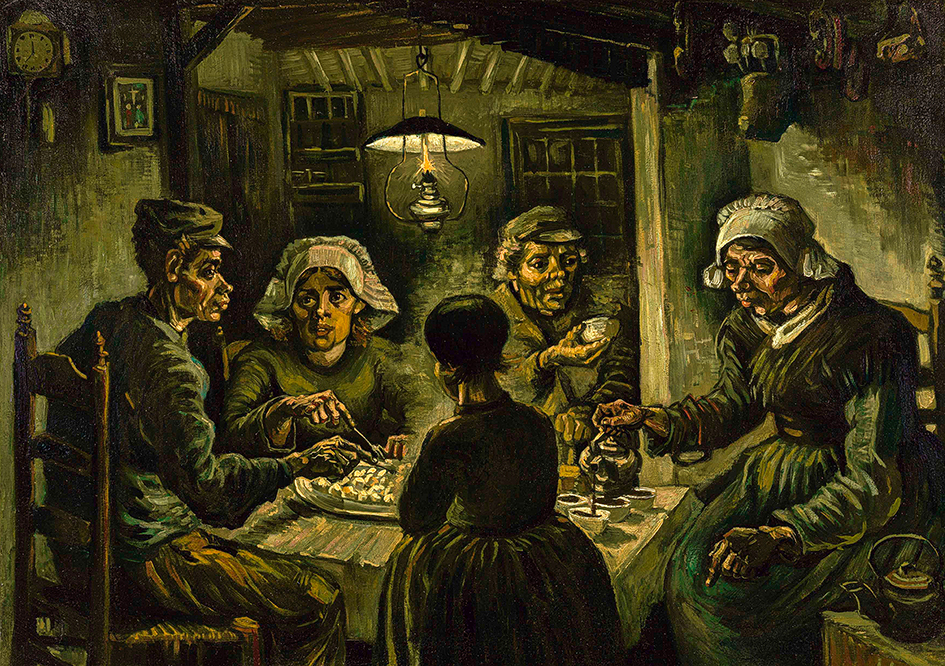
Potato Eaters
Vincent van Gogh (1853 - 1890), Nuenen, 1885, oil on canvas, 82 cm x 114 cm.
During March and the beginning of April 1885, Van Gogh sketched studies for the painting and corresponded with his brother Theo, who was not impressed with his current work nor the sketches Van Gogh sent him in Paris. He began working on The Potato Eaters while living with his parents in Nuenen, a rural town which was home to many farmers, labourers and weavers. He worked on the painting from 13 April until the beginning of May, when it was mostly done except for minor changes that he made with a small brush later the same year. Van Gogh discussed The Potato Eaters in a letter to his brother. He said that he wanted people who see it to: …get the idea that these folk, who are eating their potatoes by the light of their little lamp, have tilled the earth themselves with these hands they are putting in the dish, and so it speaks of manual labour and–that they have thus honestly earned their food. I wanted it to give the idea of a wholly different way of life from ours.... anyone who would rather see insipidly pretty peasants can go ahead. For my part, I am convinced that in the long run it produces better results to paint them in their coarseness than to introduce conventional sweetness. In the context of that discussion Van Gogh added his thoughts on peasant paintings: A peasant girl is more beautiful than a lady–to my mind–in her dusty and patched blue skirt and jacket, which have acquired the most delicate nuances from weather, wind and sun. But–if she puts–a lady’s costume on, then the genuineness is lost. A peasant in his suit of fustian in the fields is finer than when he goes to church on Sundays in a sort of gentleman’s coat. … If a peasant painting smells of bacon, smoke, potato steam–fine–that’s not unhealthy–if a stable smells of manure–very well, that’s what a stable’s for–if the field has an odour of ripe wheat or potatoes or of guano and manure–that’s really healthy … But a peasant painting mustn’t become perfumed.
Writing to his sister Willemina two years later in Paris, Van Gogh still considered The Potato Eaters his most successful painting: "What I think about my own work is that the painting of the peasants eating potatoes that I did in Nuenen is after all the best thing I did". However, the work was criticized by his friend Anthon van Rappard soon after it was painted. This was a blow to Van Gogh's confidence as an emerging artist, and he wrote back to his friend, "you... had no right to condemn my work in the way you did" (July 1885), and later, "I am always doing what I can't do yet in order to learn how to do it." (August 1885).
Email: jancvanroekel@gmail.com