Postcards |
Intro van Gogh |
His Suicide |
van Gogh postcard
beautiful offset-printed
on 320 grs carton
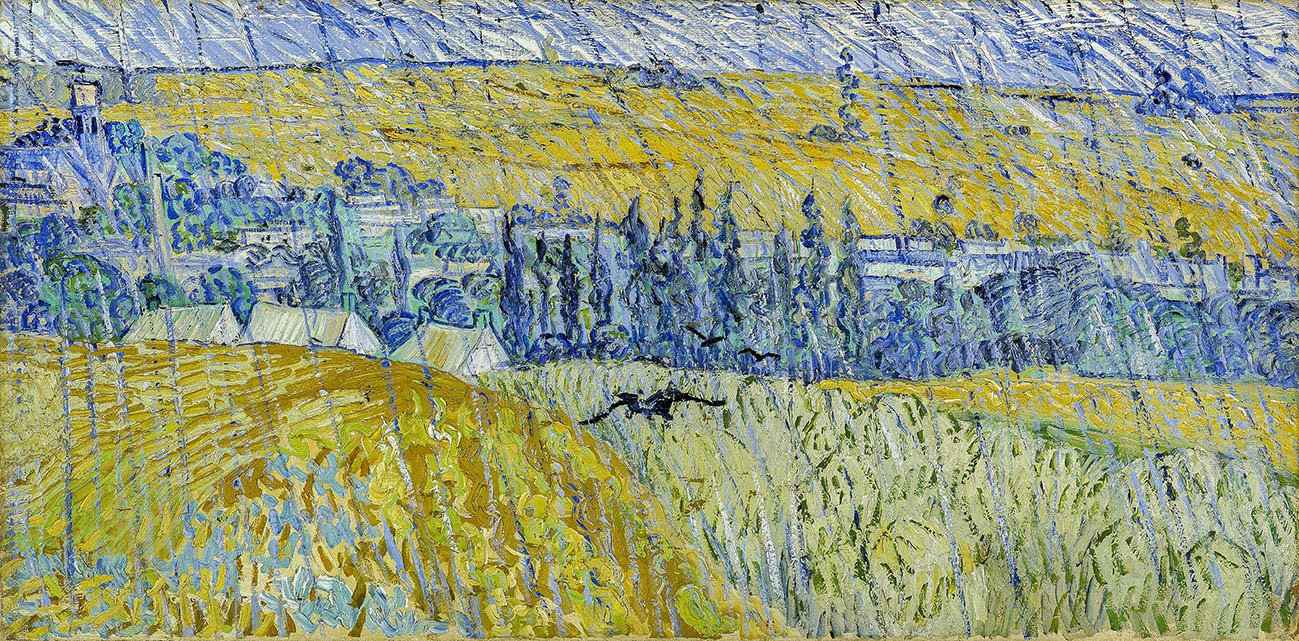
Landscape in the Rain
Vincent van Gogh (1853 - 1890), Auvers, 1890, oil on canvas, 50 cm x 100 cm.
Landscape at Auvers in the Rain is an oil painting on canvas by the Dutch Post-Impressionist painter Vincent van Gogh.
Painted in July 1890, and completed just three days before his death, it depicts a landscape at Auvers-sur-Oise, where van Gogh spent the last 70 days of his life. It is one of thirteen double-square canvases of landscapes around Auvers completed by van Gogh between 17 June and 27 July. The depiction of the rain with dark, diagonal lines is considered to be inspired by Japanese art, specifically the woodcuts of Hiroshige. It also displays the visceral relationship between nature and emotion that is a trademark of van Gogh's later work, as well as the stylistic innovations of a raised horizon line, expressive brushstrokes, and bold colours. This was one of Van Gogh's last paintings before his death and has been interpreted as symbolizing the cycle of human suffering contrasted with a sense of hope. The painting was bought by Gwendoline Davies in 1920 in Paris, and was donated to the National Museum of Wales in Cardiff as part of her bequest in 1952.
Vincent van Gogh became an artist at the age of 27, and continued painting until his alleged suicide on 29 July 1890 at the age of 37. Originally based in his home country of the Netherlands, van Gogh spent the last four years of life painting in France, where his greatest artistic innovation occurred. As his mental health declined, allegedly due to an epileptic disorder, van Gogh chose to enter a private asylum in Saint-Remy-de-Provence in the South of France. He spent fifteen months there, continuing to develop a distinct artistic style. Then, he moved to the small village of Auvers-sur-Oise in northern France, where he spent the last three months of his life. Van Gogh lived in Auvers from May to 27 July 1890. In those seventy days, the artist painted over seventy works, enjoying his newfound autonomy after being institutionalised by producing art fanatically. His main correspondences were with his brother Theo van Gogh, to whom he wrote in Paris, and Doctor Paul Gachet, a local homoeopathic practitioner who was interested in Post-Impressionist art and who kept an eye on the artist and his work. Despite his renewed freedom, van Gogh's mental health continued to deteriorate, leading to his suicide. In the last two months of his life, the artist engaged in his "most daring stylistic experiments and freed himself from any remaining academic constraints, which had still hampered his work in the previous months". Notably, he painted twelve double-square canvases of the gardens and fields around Auvers in the last ten days of his life, which displayed some of his most innovative techniques in terms of colour and composition. Landscape at Auvers in the Rain was part of this collection of works, which were probably meant to be a coherent series, and was painted within the last three days before his suicide. He clearly had decided to terminate his life.
Email: jancvanroekel@gmail.com